To Begin With
Our laboratory is a new group that started from April 2025.
High-energy physics is an experimental research field that aims to uncover new physics related to fundamental questions of the Universe—such as the nature of dark matter and the origin of matter in the Universe—by searching for physics beyond the Standard Model (BSM). This field is driven by a combination of high-energy collider experiments, exemplified by the CERN Large Hadron Collider (LHC) in Switzerland, which discovered the Higgs boson in 2013, and a wide variety of small- and medium-scale experiments that complement these collider programs.
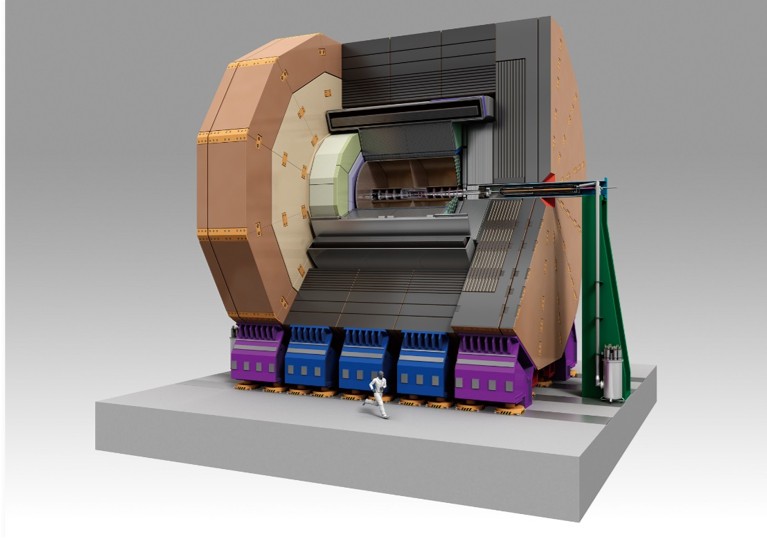
In our group, we promote research on physics and detector technologies for future collider experiments, with the goal of realizing Higgs factories such as the International Linear Collider (ILC), a proposed successor to the LHC. We also lead the EBES experiment, a beam-dump search for axion-like particles (ALPs) conducted using the accelerator facilities at the High Energy Accelerator Research Organization (KEK) in Tsukuba, making full use of our detector technologies developed for collider experiments. In addition, we actively conduct research on deep learning in collaboration with other laboratories at ICEPP, the University of Tokyo, as well as domestic and international partner institutions, so that these methods can be effectively applied to our experiments.
A Higgs factory is a global project that can only be realized through close cooperation among researchers worldwide. Working together with colleagues from France, Germany, China, and other countries, we are engaged in international collaborative research toward this goal. If you are highly motivated to work with researchers around the world, contribute to the success of large-scale international projects, and explore the mysteries of the Universe, we warmly welcome you to join us. Please feel free to contact us—we would be happy to provide further details to anyone interested.
Research Topics
More details will be available soon. In the meanwhile, please refer to my personal page: Suehara's page
For ILC-related research at ICEPP, please visit the ICEPP ILC Group webpage: ICEPP ILC group page
Major Research Topics
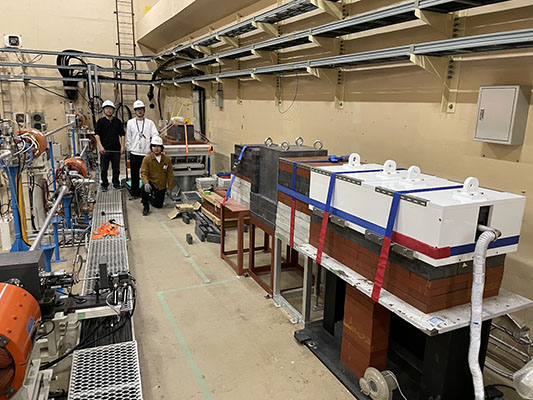
Unlike large-scale experiments, in EBES you can directly control many aspects of the experiment yourself. The opportunity to search for unknown particles with your own hands is one of the most attractive features of this project. More Information
Our group members are also taking parts in the MEG experiment and its future program (PIONEER)and the J-PARC muon g-2/EDM experiment.
Technical Development for our Major Research Topics
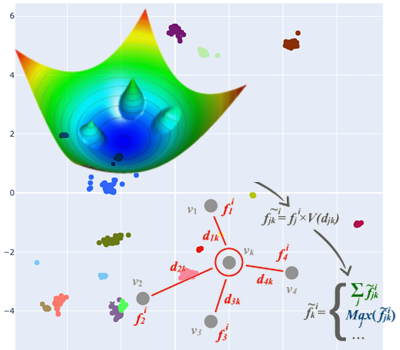
Next-generation detectors will incorporate far more detector elements than conventional systems, producing extremely rich information. Research on deep learning methods that can fully exploit this information has therefore become a top priority.