Key points
- By combining insights from the Kibble-Zurek mechanism with machine learning, the researchers clarified how and when crucial information associated with topological-defect formation emerges during nonequilibrium dynamics.
- Whereas the conventional Kibble-Zurek mechanism primarily predicts the number of topological defects formed, the researchers demonstrated that machine learning can predict the final locations of individual defects from fluctuations of the underlying field.
- By connecting microscopic fluctuations in the early stages of a phase transition with the eventual formation of topological defects, this work advances our understanding and control of phase-transition dynamics. In the future, the findings may contribute to defect control in materials science and quantum technologies, as well as to understanding phase transitions in high-energy physics and cosmology.
Overview
A research team led by Project Assistant Professor Fumika Suzuki of the International Center for Elementary Particle Physics (ICEPP), the University of Tokyo, together with Dr. Ying Wai Li and Dr. Wojciech H. Zurek of Los Alamos National Laboratory, has demonstrated that machine learning can predict where topological defects will eventually form from extremely small fluctuations appearing near the critical point of a phase transition.
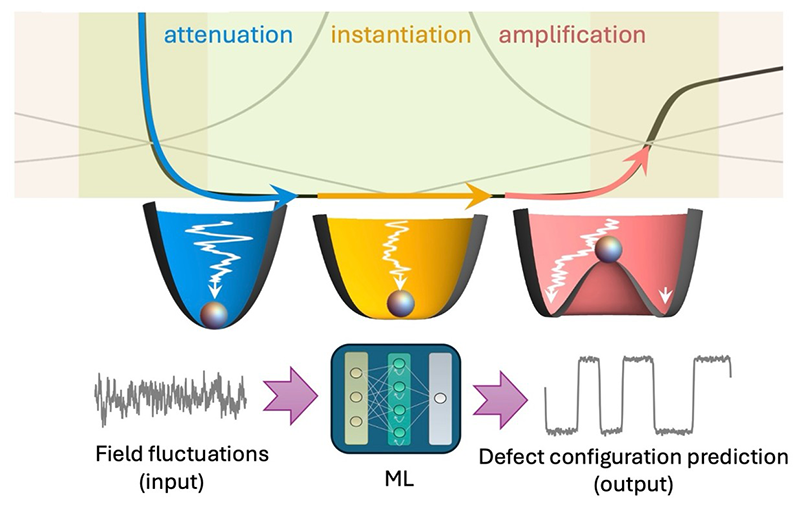
The researchers further discovered that the time at which machine learning begins to successfully predict the future positions of defects follows the universal scaling law of the Kibble-Zurek mechanism. Based on these findings, they propose a new picture of nonequilibrium dynamics describing when and how topological defects are born: attenuation-instantiation-amplification (aia) dynamics.
The results were published online in Physical Review Letters on October 5, 2026, at 3:00 p.m. U.S. Eastern Daylight Time.
Research Results
【Background】
Phase transitions play an important role in understanding a wide variety of physical phenomena, ranging from changes in everyday materials to the evolution of the early Universe. During a phase transition, different regions of a system may independently choose different states. Structures known as topological defects can then form at the boundaries between these regions.
Topological defects can influence the properties of materials and the behavior of quantum systems, and they may also have formed during the evolution of the early Universe. It has further been suggested that signatures of such defects could potentially be observed through gravitational waves. Understanding when, where, and through what mechanisms topological defects are created is therefore an important problem for understanding nonequilibrium phase-transition dynamics across fields ranging from materials science to cosmology.
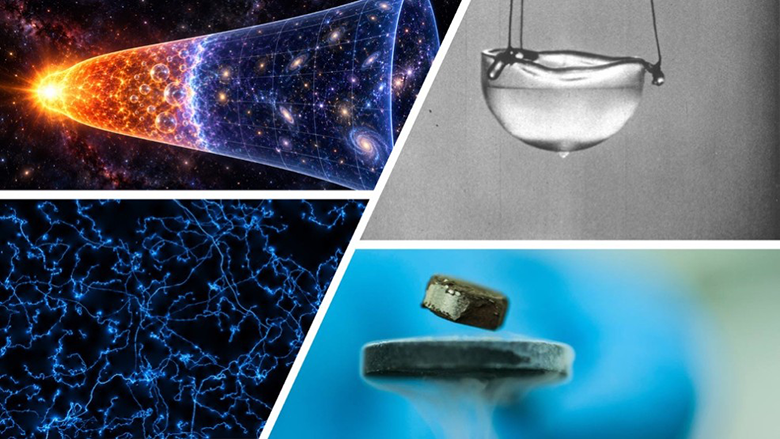
The study of phase transitions and topological defects plays an important role across a broad range of fields, from condensed-matter and quantum physics to high-energy physics and cosmology.
One of the best-known theoretical frameworks describing defect formation during phase transitions is the Kibble-Zurek mechanism. This mechanism universally predicts how the number of defects formed depends on the rate at which a phase transition is crossed. However, the more microscopic process-when each individual defect is born and where it will ultimately form?has remained much less well understood.
【Findings】
In this study, the researchers introduced machine learning as an analysis tool to investigate how topological defects form during a phase transition. Using a recurrent neural network, they examined whether the final positions of topological defects could be predicted from fluctuations of the field observed during the transition.
They found that the future positions of defects can be predicted with high accuracy from extremely small fluctuations appearing near the critical point, well before the defects themselves become clearly visible.
The researchers then examined in detail the time at which machine-learning predictions first become possible. Remarkably, they found that this time itself follows the universal scaling law predicted by the Kibble-Zurek mechanism. This result indicates that the formation of information determining the eventual defect configuration is also governed by a universal timescale associated with the Kibble-Zurek mechanism.
At the same time, the study revealed that signatures of the final defect configuration already appear within microscopic fluctuations much earlier than the stage at which the defects become macroscopically visible.
Based on these results, the research team proposes a new picture of nonequilibrium dynamics called aia dynamics. In this picture, fluctuations are first suppressed (attenuation); information associated with the future defect configuration is then encoded within small fluctuations (instantiation); and finally, these microscopic differences are amplified (amplification) until they develop into macroscopic domains and observable topological defects.
【Significance and Future Outlook】
This study goes beyond the number and statistical properties of topological defects traditionally predicted by the Kibble-Zurek mechanism and provides a new framework for investigating the microscopic formation process-namely, when and where individual defects are formed.
Extending this approach to more complex phase transitions and a wider range of physical systems may provide a more detailed understanding of how topological defects emerge.
The method may also be applicable to inverse problems, in which information about the final defect configuration, correlation length, and other observables is used to infer the earlier phase-transition dynamics or initial fluctuations.
In the future, machine-learning approaches of this kind may find applications across a broad range of fields, from controlling defects in materials and quantum technologies to understanding electroweak phase transitions and phase-transition dynamics in the early Universe.
Researchers
Dr. Fumika Suzuki (International Center for Elementary Particle Physics, The University of Tokyo)
Dr. Ying Wai Li (Computing and Artificial Intelligence Division, Los Alamos National Laboratory)
Dr. Wojciech H. Zurek (Theoretical Division, Los Alamos National Laboratory)
Publication Information
Journal: Physical Review Letters
Title: Machine learning topological defect formation: When are the defects made?
Authors: Fumika Suzuki, Ying Wai Li, and Wojciech H. Zurek
DOI: 10.1103/fstv-lsvh
URL: https://doi.org/10.1103/fstv-lsvh
Funding
This research was supported by Google.org, the Laboratory Directed Research and Development (LDRD) program(Project Nos. 20230049DR, 20250614CR-NLS, and 20240083DR), and the Office of Science.